

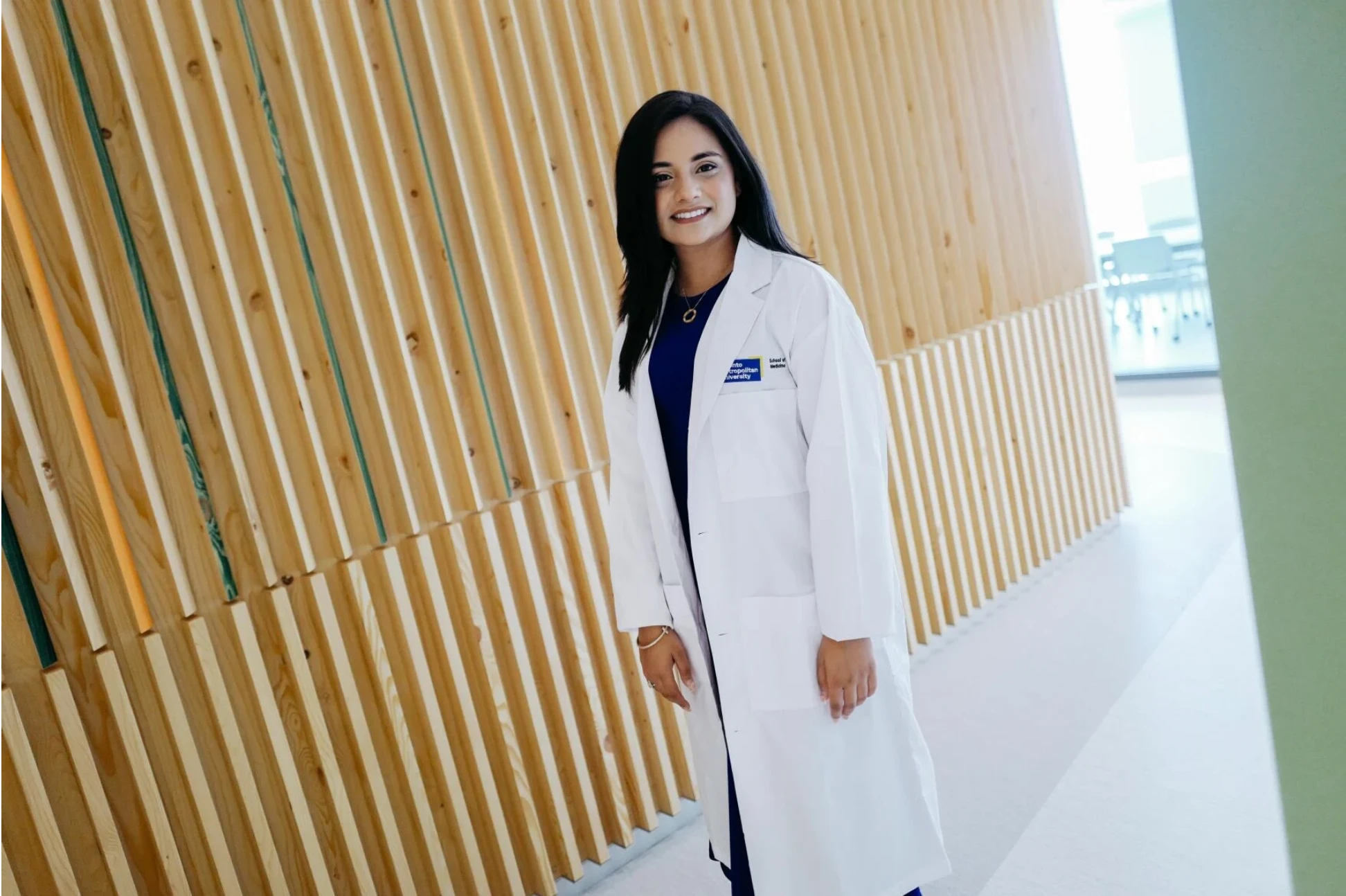
A doctor understood the needs of her immigrant family when she was 8. She’s starting TMU med school, hoping to practice in the region where she grew up
Kenisha Arora was just eight years old when she had to translate lab results and doctor’s orders for her Hindi-speaking parents — explaining her diagnosis of hypothyroidism, which she barely understood herself.
The treatment plan included a drastic shift in diet: more protein, more meat. But the guidance didn’t reflect the cultural reality of what was on her family’s plates, the vegetarian dishes and the high-sodium masalas and pickles. Her immigrant parents, working long hours, often leaned on takeout or prepackaged foods.
Then a South Asian doctor took over Arora’s care.
Instead of prescribing a western diet, he suggested homemade spice blends, rinsing canned chickpeas to reduce the salt, cutting back on sugar in their sweet milky chai and measuring oil with tablespoons instead of by instinct.
The difference was profound.
“The food still tasted like us; it still felt doable for my mom,” says Arora. “And over time, I saw how just those 10 minutes of teaching changed the next 10 years of our family’s health.”
That doctor’s appointment in Brampton was a powerful lesson about the interconnectedness of health and education — a theme that has guided Arora through post-secondary studies to global stages, and now on to Toronto Metropolitan University’s new medical school, where she hopes to return that same understanding and care to the community that raised her.
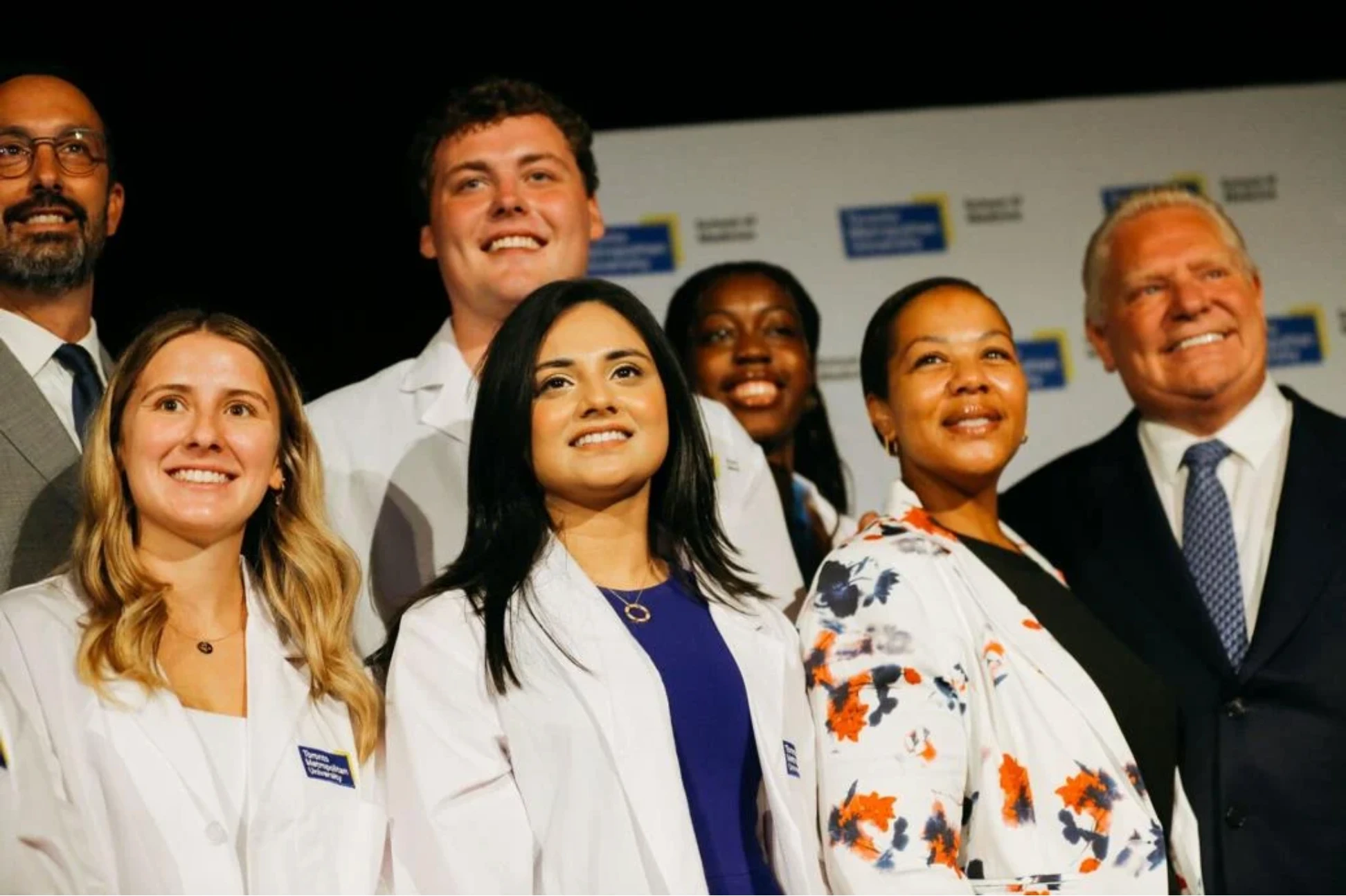
On Wednesday, Arora and 16 other members of the Class of 2029, all dressed in white lab coats, were welcomed with a standing ovation as they filed onto the stage inside the former Bramalea Civic Centre for the school’s official opening ceremony. The rest of the first-year students were seated in the auditorium, which overflowed with dignitaries from all levels of government and the university itself.
“The launch today is more than a celebration, it’s a promise, ” said TMU president Mohamed Lachemi, “a promise to bring better, more accessible health care to Brampton and Ontario; a promise to train doctors who understand and reflect the communities they serve; and a promise to lead change.
”Premier Doug Ford and Brampton Mayor Patrick Brown, buoyed by Orlando Corp.’s announcement of a donor-matching gift of up to $25 million, were all smiles, exchanging praise on what Ford called a “historic day.”
The medical school is the first in Greater Toronto since the University of Toronto established its faculty well over a century ago.
Touting itself as “a new kind of med school,” TMU has vowed to intentionally embed principles of community-centred practice, cultural respect, and equity throughout its program. Amid a severe shortage of family doctors in Ontario, the school is placing a strong emphasis on primary care — especially in underserved areas like Peel Region, where the campus is located.
Applicants were invited to describe their connection to the region and their interest in practising there. Additionally, the school’s primary clinical partner is William Osler Health System, a hospital system serving Brampton/Peel Region.
TMU launched its residency program earlier this summer with a cohort of 150.
The school received 6,415 applications for 94 seats. About one-third of offers went to applicants from Peel Region, but TMU would not reveal how many local students ultimately accepted other than to say there is “strong representation.”
“To our learners, you are the heart of the school and the hope for a happier future,” Lachemi said to the students, who have come from backgrounds in public health, nursing and epidemiology, among others.
Their marks and impressive experience run counter to criticisms that the admission process — designed to reduce barriers and promote diversity by requiring a minimum 3.3 GPA , no prerequisite courses and no MCAT — would compromise the quality of candidates. The average GPA of the inaugural class is 3.8; for next year, the minimum requirement has been set at 3.5.
TMU has made “the pathway into medicine more equitable without compromising on competence,” says Arora, 22. “If anything, it raises the bar because they’re admitting people who not only can handle the academics but also bring the lived experiences and values that translate into better care for patients.”
For Arora, the power of lived experience isn’t theoretical — it’s grounded in her own journey.
Prescription for success
As a kid, Arora was fascinated by science.
She vividly remembers being captivated by a pig’s heart and sheep’s brain that were part of a Grade 5 science workshop. “It was kind of love at first touch,” she says, giggling at the memory. As she traces the trajectory of her life, Arora, who immigrated with her parents from India when she was two, regularly refers to entries in her childhood diaries, retrieving her early impressions even if details have grown hazy.
That includes what she felt like in consultations with physicians as they treated her hormonal condition that affected her metabolism and energy levels: “I thought how unfair it was for a child to have to navigate some of these adult conversations about cholesterol or blood pressure.” But it was early training for a future career.
At home, education was of utmost importance. Her parents, who first landed in Montreal before moving to Brampton and eventually Mississauga, would teach themselves the Ontario math curriculum and buy textbooks at Costco to help prepare Arora and her younger sister for the start of each academic year. “My parents really wanted to see us be the best versions of ourselves and have opportunities they didn’t have.”
Arora attended the International Business and Technology program at Lisgar Middle School and later Glenforest Secondary. There, the rigorous International Baccalaureate program helped shaped her global perspective, she says, providing her with a deeper understanding of systemic inequities.
That knowledge fueled action. While serving as a student trustee with the Peel District School Board, Arora learned that one in seven Canadian girls were missing class because they couldn’t afford menstrual products. So she persuaded some initially reluctant board colleagues to pass a motion ensuring free pads and tampons in school washrooms.
Arora’s advocacy continued even as she went to Western University to study medical science. In addition to serving on the school’s board of governors, she was selected out of thousands of candidates worldwide to be the youth representative on the United Nations SDG4 High-Level Steering Committee, whose goal was to drive and track equitable, inclusive education around the world.
In any given week, she’d find herself in an anatomy class on a Thursday, board an overnight flight to deliver a speech at UNESCO headquarters in Paris, and then travel to New York for a meeting on Monday at the United Nations, where she would find herself sandwiched between world leaders. Stealing moments to study on trains and planes, she would then return to Western’s campus in London, Ont., ready to do it all again.
The experience “demanded a lot of discipline and humility, and it taught me how to carry multiple worlds at the same time,” she says.
She also discovered doctors were largely missing from high-level discussions on education.“I didn’t see anyone who lived the kind of interconnected life I envisioned for myself, one that weaves together medicine, policy and community.”
Although discouraging, it clarified the type of physician she aspired to be. “A patient to me is not just a diagnosis, they are a whole human being shaped by their housing conditions, their immigration status, by education, by income or even by the quality of air that they are privileged or not privileged enough to breathe. Medicine, to me, has to meet all of those dimensions.”
She deepened this broad perspective over the past year while at Johns Hopkins University in Baltimore, where she completed a master’s in global health and education.
But her eye was always on TMU, from the day she first heard the university would be establishing a medical institution that aimed to “innovate, disrupt and drive change.” “Part of me, in my heart, knew that the school was made for me.”
And she for the school, says Dean Teresa Chan, noting that Arora’s “demonstration of academic excellence, exceptional experience and dedication to public service will play a vital role in how we’re innovating the future of health care.”
For now, there is personal joy in moving back home, with her parents: “I’m so happy because these are the streets I used to play hopscotch on with my cousins.”
But for a woman who will be the first physician in her extended family, there is also a full-circle moment, to be what that doctor was to her family so many years ago.
“Being part of this first cohort is an opportunity to create a legacy and shape the next generation of medical students and leaders.”